دَاوُد
A stone, a sling, and the faith of a shepherd boy — how Dawud slew Goliath and inherited a kingdom
The Shepherd and the Giant
The Stone in the Sling
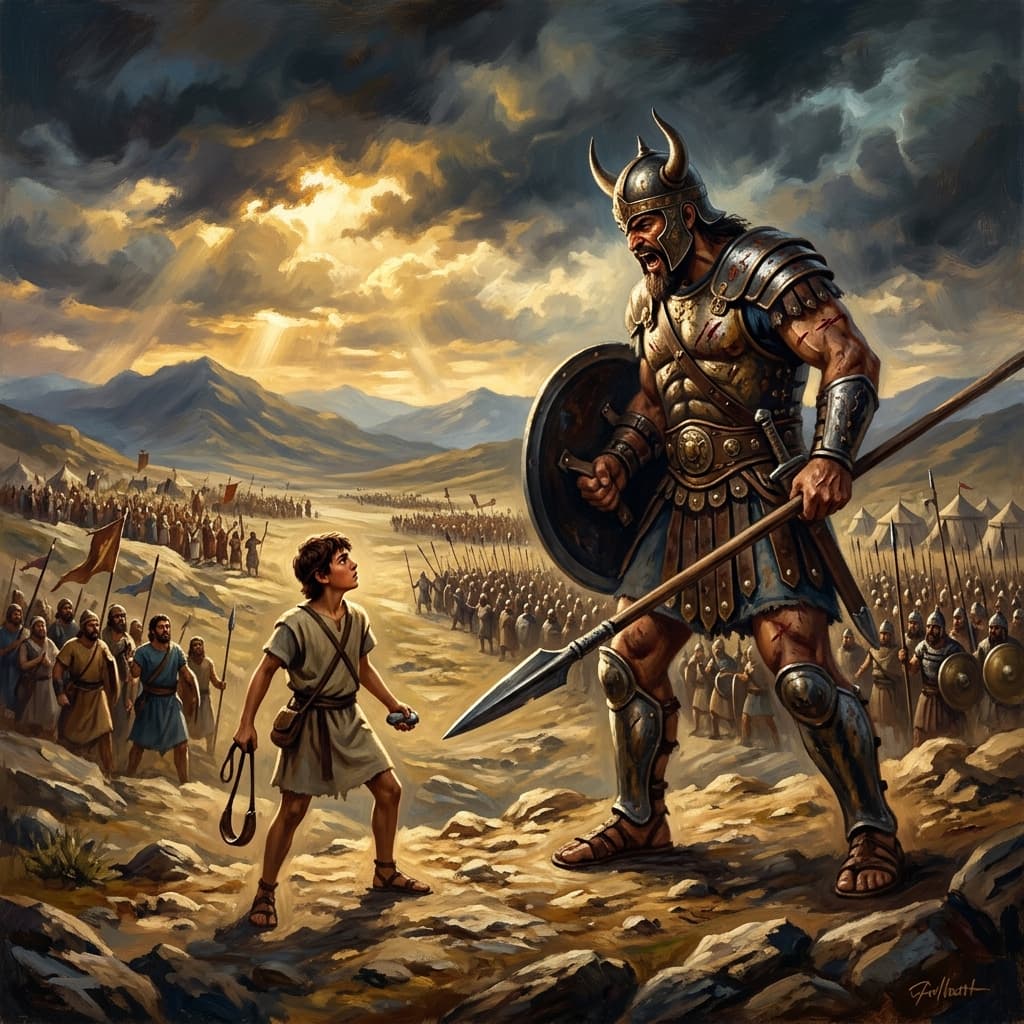
The army of the Israelites stood in their valley, and Goliath's army stood in the valley opposite. Every morning and evening, Goliath strode forward and issued his challenge: send one man to fight me. The Israelite soldiers looked at each other. No one moved. Forty days passed like this. Then a shepherd boy arrived at the camp, bringing food for his brothers.
Dawud was not a soldier. He was a shepherd — a young man who had spent his years in the fields, guarding his father's flock. He had faced lions and bears with nothing but his staff and his faith. He looked at Goliath, massive and armored and terrifying, and felt something click into place. He went to the king: "Let no man's heart fail because of this giant. Your servant will go and fight him."
The king tried to give him armor — his own armor, the finest available. Dawud put it on, took a few steps, and took it off. "I cannot walk in this — I'm not used to it." He went back to his shepherd tools: a staff, a sling, and five smooth stones from the stream. He chose the weapons he knew. He trusted the hands God had trained.
فَهَزَمُوهُم بِإِذْنِ اللَّهِ وَقَتَلَ دَاوُودُ جَالُوتَ وَآتَاهُ اللَّهُ الْمُلْكَ وَالْحِكْمَةَ
"So they defeated them by the permission of God, and Dawud killed Goliath, and God gave him the kingship and wisdom."
— Surah Al-Baqarah, 2:251
Goliath laughed when he saw the boy approaching. Dawud placed a stone in his sling, swung it once, and released it. The stone found its mark. The giant fell. The army that had terrified the Israelites for forty days broke and fled. One stone. One faith. One boy who knew where his strength came from.
The King Who Wept
God gave Dawud the kingship, the Zabur (Psalms), and something rarer than both: a voice. When he glorified God, the mountains joined him. The birds froze in mid-flight to listen and repeat his praises. God had made the natural world his choir — and its conductor was a man weeping at dawn.
Iron was made soft and malleable in Dawud's hands — he could shape it as easily as clay. He made coats of chainmail with it, teaching the craft to protect soldiers in battle. God gave him mastery over the physical world as a reflection of the spiritual mastery he had earned.
Then came the trial. Two men came to Dawud's chamber — not through the door, but over the wall. He was startled. They said they had a dispute: one had ninety-nine ewes, and the other had one. The owner of ninety-nine wanted the single one too. Dawud said immediately: "He has wronged you." And in that quick judgment, God revealed a lesson: he had judged before hearing both sides. Dawud's heart cracked open with the realization. He prostrated and wept — and wept — and wept.
فَاسْتَغْفَرَ رَبَّهُ وَخَرَّ رَاكِعًا وَأَنَابَ
"So he sought forgiveness of his Lord and fell down bowing and turned in repentance."
— Surah Sad, 38:24
God forgave him and told him: "O Dawud, We have made you a khalifah on Earth, so judge between people with truth." A king with ninety-nine blessings, weeping over one wrong. That is the character of a prophet-king — to whom much is given, much accountability is required. The Psalms of Dawud — the Zabur — were the outpouring of that heart: a man before his Lord, transparent, broken, and grateful.