إِبْرَاهِيم
From a boy who questioned idols to a man who walked through fire — the life of the Friend of God
The Flame That Did Not Burn
The Idol Breaker
In a city of stone gods, a boy looked up at the stars. He watched them through the night — the stars, the moon, the sun — and he asked them all: "Are you my Lord?" One by one, they set. One by one, he turned away. "I do not love things that set," he said. And in that turning away from everything that passes, he turned toward the One who does not.
Ibrahim was born into a family of idol-makers. His father Azar carved the stone gods that his city worshipped. Ibrahim grew up watching people bow to objects that could not hear, speak, eat, or defend themselves. His mind refused to accept it. While still a young man, he engaged his father with a question so direct it cut like a blade: "Father, why do you worship what cannot hear or see or benefit you at all?"
إِذْ قَالَ لِأَبِيهِ يَا أَبَتِ لِمَ تَعْبُدُ مَا لَا يَسْمَعُ وَلَا يُبْصِرُ وَلَا يُغْنِي عَنكَ شَيْئًا
""Father, why do you worship what cannot hear or see, and cannot benefit you at all?""
— Surah Maryam, 19:42
On a festival day when the city emptied to celebrate, Ibrahim entered the temple alone. Before him stood a hall of idols — the great ones at the back, the lesser ones lined up in rows. He looked at them. He asked them, "Will you not eat?" — for offerings had been placed before them. He looked at the food going untouched, at the stone faces with no awareness. Something broke open in him. He raised the axe.
He smashed every idol except the largest, and hung the axe around the neck of the chief idol. When the people returned and found the devastation, they demanded: "Who did this to our gods?" Someone remembered the young man who questioned the gods, and they brought Ibrahim before the gathered assembly. "Did you do this?" He smiled: "Ask the one with the axe — if they can speak."
In that moment, something shifted in the crowd. They looked at their great god — incapable of answering, incapable of defending itself, incapable of anything. They felt the force of the argument. Then pride surged back. "You know very well that these things cannot speak." Ibrahim's response was devastating: "Then why do you worship things that have no power to benefit you or harm you? Do you not think?" The crowd had no answer except fury.
Into the Fire
Nimrod, the king who had declared himself a god, summoned Ibrahim to his court. "Your God — what does He do?" Ibrahim answered: "My Lord gives life and causes death." Nimrod smirked. "I give life and cause death." He called for two prisoners — executed one, freed the other. "See — I give life and death." Ibrahim shifted without hesitation: "My Lord brings the sun from the east — bring it from the west." Nimrod had no answer. The debate was over. But power has never needed to win arguments to act on its will.
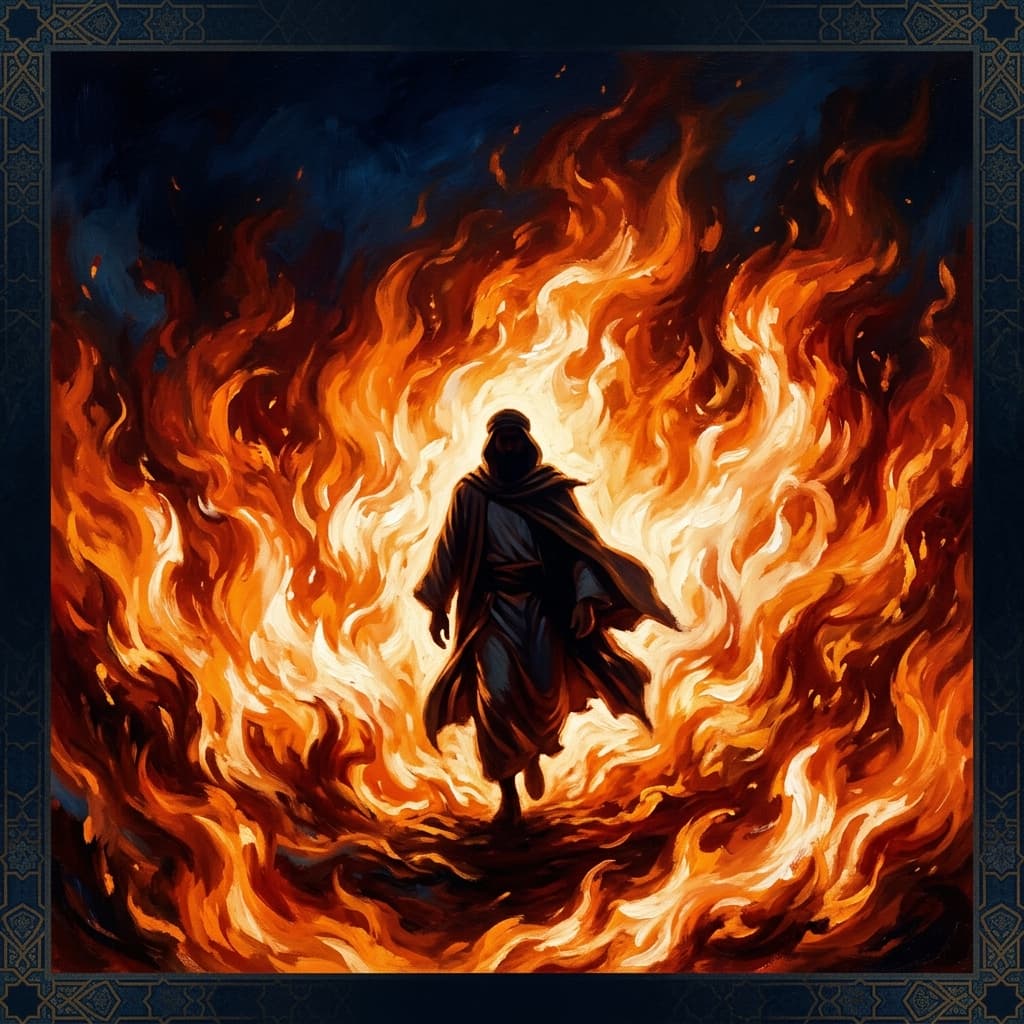
The verdict came down: burn him. The people of the city gathered wood for days. They built a fire so immense that birds flying overhead were scorched from the heat. They constructed a catapult to hurl Ibrahim into it — because no human could approach the blaze closely enough to throw him in by hand. As they prepared the mechanism and placed Ibrahim in it, an angel came to him. "Ibrahim — do you need anything?" Ibrahim looked at the fire, then at the angel: "From you? No."
قُلْنَا يَا نَارُ كُونِي بَرْدًا وَسَلَامًا عَلَىٰ إِبْرَاهِيمَ
"We said: "O fire, be cool and safe upon Ibrahim.""
— Surah Al-Anbiya, 21:69
God commanded the fire: be cool and safe for Ibrahim. In all of history, those words stand as one of the most extraordinary divine commands — God speaking directly to the element He created, reversing its nature by His will. Ibrahim was hurled through the air and landed in the heart of the inferno. And he sat there. Unburnt. Serene. The ropes binding him burnt away but his skin was untouched. Nimrod watched from a distance, unable to comprehend what his eyes were seeing.
Ibrahim emerged from the fire unchanged — except, perhaps, more certain than ever before. God did not spare him the trial. He let him be thrown in. But He had prepared the outcome before the first log was lit. This is the pattern of God's tests: He does not shield the beloved from hardship. He shields them within it.
son
Ismail
Years later, God would test Ibrahim again — this time with the life of his firstborn son Ismail. The father who walked through fire would be asked to lay his son on the altar.
Ibrahim left his homeland and traveled, guided by God, through the ancient world. He built the Kaaba in Mecca with his son Ismail — lifting the stones, laying them in place, praying: "Our Lord, accept this from us. You are the All-Hearing, the All-Knowing." The house they built became the most visited place on Earth, a point toward which billions of hearts have turned, a qibla that outlasted every empire that has ever tried to erase it.