مُحَمَّد
The night in the Cave of Hira that changed the world — the first revelation of the Quran
The First Light
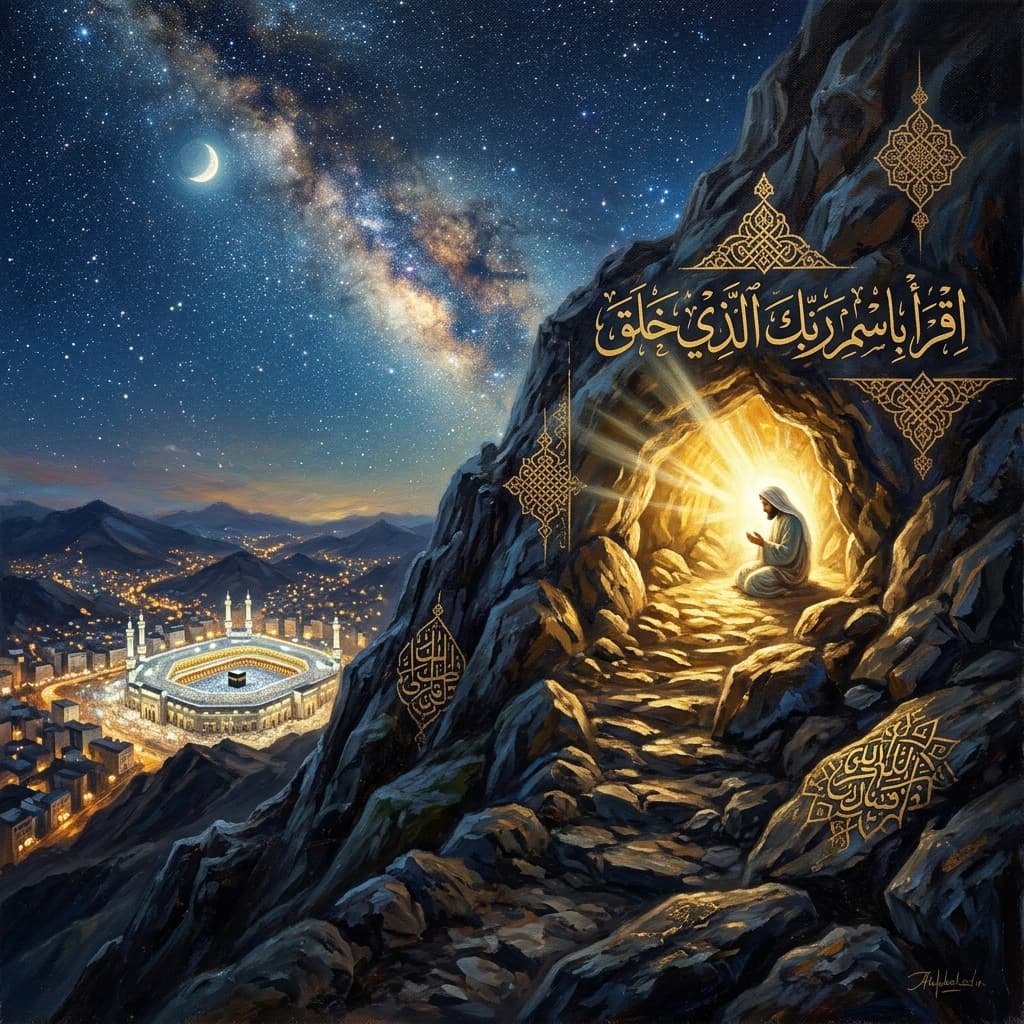
The Cave of Hira
For forty years, he had lived in Mecca. He had watched the Kaaba — built by his ancestor Ibrahim — become a house of idols. He had watched his people bury their daughters alive, enslave the weak, and worship stone. Something in him could not accept it, could not be at peace with it. He began to retreat to a cave in the mountain of Hira above the city — withdrawing from the world, sitting in the silence, seeking something he had no name for yet.
He would go up for days at a time, alone, with a supply of dates and water. He sat in the dark cave and thought about the universe, about creation, about the One who made it all. Khadijah would send food when he was overdue. The mountain waited. The cave waited. And one night, in the month of Ramadan, something came.
The angel Jibreel appeared. Not gradually, not gently — he came with an overwhelming presence that filled the cave and the night and perhaps the space between them. He embraced Muhammad ﷺ with a force that felt like all the world was pressing in. "Iqra" — Read. Muhammad ﷺ, who could not read, said: "I cannot read." The embrace again. "Iqra." Again the answer: "I cannot read." A third time. Then the first words of the Quran poured from the angel into the Prophet's heart:
اقْرَأْ بِاسْمِ رَبِّكَ الَّذِي خَلَقَ خَلَقَ الْإِنسَانَ مِنْ عَلَقٍ اقْرَأْ وَرَبُّكَ الْأَكْرَمُ
""Read in the name of your Lord who created — created man from a clinging clot. Read, and your Lord is the Most Generous.""
— Surah Al-Alaq, 96:1-3
The angel left. The cave was ordinary again — stone, darkness, the distant lights of Mecca below. Muhammad ﷺ stumbled down the mountain, his heart pounding with something he had never felt before — not fear exactly, but a trembling that went deeper than fear. He ran home to Khadijah and said: "Cover me, cover me." She wrapped him in her cloak and held him until the trembling passed. Then she listened as he told her what had happened.
The Weight of Words
Khadijah did not panic. She did not doubt. She looked at the man she had known for fifteen years — the most honest man she had ever met — and she said: "God will never disgrace you." She listed his qualities one by one: you uphold family ties, you speak the truth, you carry others' burdens, you give to the poor, you serve your guests generously, you assist the afflicted. She was naming his character as evidence of his calling. Then she took him to her cousin Waraqah, a Christian scholar who had studied the ancient scriptures.
spouse
Khadijah
Khadijah was the first to believe. Her calm certainty in that first terrifying night became the foundation on which the mission began.
Waraqah listened. His old eyes widened. He said: "This is the Namus — the same angel who came to Musa. Your people will call you a liar, banish you, and make war against you." He wished he were younger, so he could live to see it. He confirmed what Khadijah had already known: this was not a trick of the mind. This was the beginning of something the world had been waiting for.
The revelation paused after that first night — a period called the Fatra, the interval — leaving Muhammad ﷺ in a state of intense longing. When it resumed, the Quran said: "O you wrapped in a cloak — arise and warn." The private moment in the cave became a public mission. The retreat became a return. The man who had withdrawn from society was now sent back into it, carrying something that would outlast every empire, every civilization, and every century until the last day of the world.
He began to speak. The first to believe was Khadijah. Then Ali, the young cousin in his household. Then Abu Bakr, his closest friend. The message was simple and world-shaking: there is no god but God. Stop worshipping stone. Live justly. Care for the poor. The words cost him everything — his social standing, his safety, the comfort of belonging to his tribe. And he kept speaking. For twenty-three years, the words kept coming. A Book was being assembled, word by word, revelation by revelation, in the heart of a man who could not read — and it has never been lost.
وَمَا أَرْسَلْنَاكَ إِلَّا رَحْمَةً لِّلْعَالَمِينَ
""And We have not sent you, [O Muhammad], except as a mercy to the worlds.""
— Surah Al-Anbiya, 21:107
The cave of Hira still stands above Mecca. Millions climb it each year, standing in the small dark hollow where the world changed, trying to feel something of that first night. The mountain is ordinary stone. The cave is a modest space. But the word that was spoken there — Iqra — became the opening of a message that has shaped the lives of billions of human beings. It is the most read, most memorized, most recited text in the history of humanity. And it began with a man alone, in a cave, in the dark, seeking something he had no name for.