مُوسَى
From the basket on the Nile to the burning bush at Sinai — how a man became the liberator of a nation
The Burning Bush
The Basket in the River
Pharaoh had a dream, and the dream terrified him. His astrologers interpreted it: a boy would be born among the Israelites who would bring down his kingdom. The command came down like the decree of a tyrant god: every male child born to the Israelites shall be killed. The river Nile turned red with the grief of mothers.
Into this world, Musa was born. His mother looked at her infant son and was overwhelmed by a love she could barely contain — and a terror that matched it. She knew she could not hide him for long. Then God inspired her with one of the most extraordinary instructions ever given to a parent: put him in a basket and cast him into the Nile. "Do not fear and do not grieve — We will return him to you and make him one of the messengers." She obeyed. She placed her son in a wicker basket, sealed it, and released it into the current of the great river.
وَأَوْحَيْنَا إِلَىٰ أُمِّ مُوسَىٰ أَنْ أَرْضِعِيهِ فَإِذَا خِفْتِ عَلَيْهِ فَأَلْقِيهِ فِي الْيَمِّ
""We inspired the mother of Musa: nurse him, and if you fear for him, cast him into the river.""
— Surah Al-Qasas, 28:7
The basket drifted downriver and into the palace of the man who had ordered the killing of every Israelite infant boy. The women of Pharaoh's household found it. They opened it and a baby looked up at them. Pharaoh's wife Asiya — one of the greatest women in Islamic history — looked at the child and was filled with love. "Let him be a comfort to my eye," she said to Pharaoh. "Perhaps he will be useful to us, or we might adopt him as a son."
But the infant Musa refused every wet-nurse they brought. He would not feed. He was searching, in the wordless way of infants, for something he recognized. His sister — who had been following the basket along the riverbank — came forward with an idea: "Shall I direct you to a household who will nurse him for you and take good care of him?" They agreed. She went and brought his own mother. The child who had been cast into the river was returned to his mother's arms in the palace of the man who wanted him dead. God's promise was kept: the most endangered infant in Egypt was also the safest.
The Voice in the Fire
Musa grew up in Pharaoh's palace — raised on its food, educated in its courts, yet carrying within him an identity that could not be buried. One day he came upon an Egyptian beating an Israelite. He intervened. He struck the Egyptian once — and the man died. It was an accident, but the act defined his life. He fled Egypt the next day, alone, in fear, with nothing but the clothes on his back.
He walked to Midian — days of desert travel, alone, without provisions. Near the well of Midian, he found a crowd of men watering their flocks, and two young women standing apart, waiting. He asked what they were waiting for. "We do not water until the shepherds move aside," they said, "and our father is a very old man." Musa watered their flocks for them without asking for anything. Then he turned to the shade and made the most direct, dignified prayer of poverty ever recorded: "My Lord, I am in need of whatever good You might send me."
رَبِّ إِنِّي لِمَا أَنزَلْتَ إِلَيَّ مِنْ خَيْرٍ فَقِيرٌ
""My Lord, I am, for whatever good You would send down to me, in need.""
— Surah Al-Qasas, 28:24
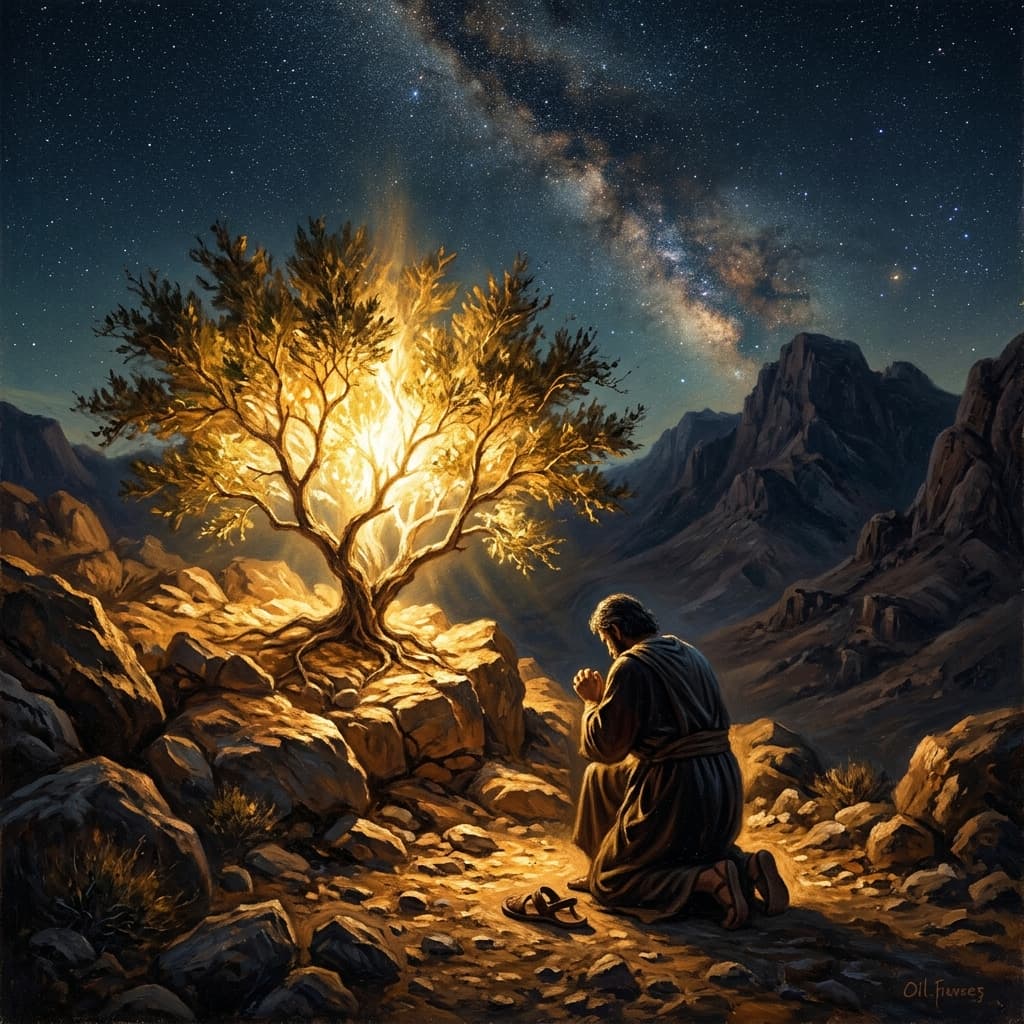
The old man — Shuaib, the prophet of Midian — invited Musa to his home, gave him work tending his flocks, and gave him one of his daughters in marriage. Ten years passed. The fugitive became a husband, a shepherd, a father. Egypt must have seemed like another life. Then one night, traveling through the dark Sinai wilderness with his family, Musa saw a fire on the slope of a mountain. He told his family to wait and went toward it — looking, perhaps, for warmth, for directions. He found something else entirely.
From the right side of the valley, from a tree — a tree ablaze, yet not consumed — a voice called: "Musa." No title. Just his name. "I am God, Lord of the Worlds." The universe shifted. The shepherd became a prophet. God spoke to him directly, without intermediary, without veil. He gave him two signs — his staff became a serpent, his hand came out gleaming white. And then He gave him his mission: "Go to Pharaoh — he has transgressed all bounds."
brother
Harun
Musa asked God for his brother Harun to be his helper — "He is more eloquent in speech than I am." God granted the request.
Musa's response to this assignment was painfully human. He listed his obstacles: he was wanted for a killing in Egypt; he was not eloquent; Pharaoh was the most powerful man in the world. God's answer to each objection was the same: I am with you. I hear and I see. When Musa asked for Harun as his partner, God granted it. When he expressed fear, God said: "Do not be afraid — you are the higher ones." The mission that seemed impossible was guaranteed by the only Guarantee that matters.