نُوح
950 years of preaching, a flood that covered the earth, and the man who kept faith when no one listened
The Great Ark
950 Years
Consider what it means to call a people to God for 950 years. Not a year. Not a decade. Nine hundred and fifty years of preaching, reasoning, warning, and pleading — and then, at the end of it, to count the believers on one hand. Nuh was not a failed prophet. He was the most patient one.
Nuh tried every approach he could conceive. He called in public and in private. He spoke gently and urgently. He reminded them of God's blessings — the rain, the crops, the rivers, the children. He told them the good news that awaited the believers, and the warning that awaited those who continued. He said: "Seek forgiveness from your Lord — for He is the All-Forgiving. He will send rain in abundance upon you, and increase your wealth and your children, and give you gardens and rivers." And they covered their ears.
قَالَ رَبِّ إِنِّي دَعَوْتُ قَوْمِي لَيْلًا وَنَهَارًا
""My Lord, I have called my people night and day.""
— Surah Nuh, 71:5
His people did not merely reject — they mocked. They gathered their children and pointed at Nuh, passing on their contempt like an inheritance. "The only ones who follow you are the lowly and the poor," they said. They wore their arrogance as armor. They told him to bring the punishment he threatened — to prove that his God was real. Nuh said: "Only God can bring it, if He wills — and you will not be able to escape."
After centuries, Nuh's prayer changed. He had pleaded for his people for so long. Now he prayed for something else: "My Lord, do not leave on Earth a single dwelling of the disbelievers — for if You do, they will lead Your servants astray, and they will produce only wicked, ungrateful offspring." It was not a prayer of hatred. It was the prayer of a man who, after 950 years, understood that some doors close.
Build the Ark
God spoke to Nuh: "Build the Ark under Our eyes and by Our inspiration — and do not speak to Me about the wrongdoers. They shall be drowned." So in a land far from any sea, with no shipbuilding tradition, an old man began to build a massive vessel. His people walked past it and laughed. "Ah, the prophet who became a carpenter!" they jeered. Nuh replied: "If you laugh at us, we too will laugh at you as you laugh."
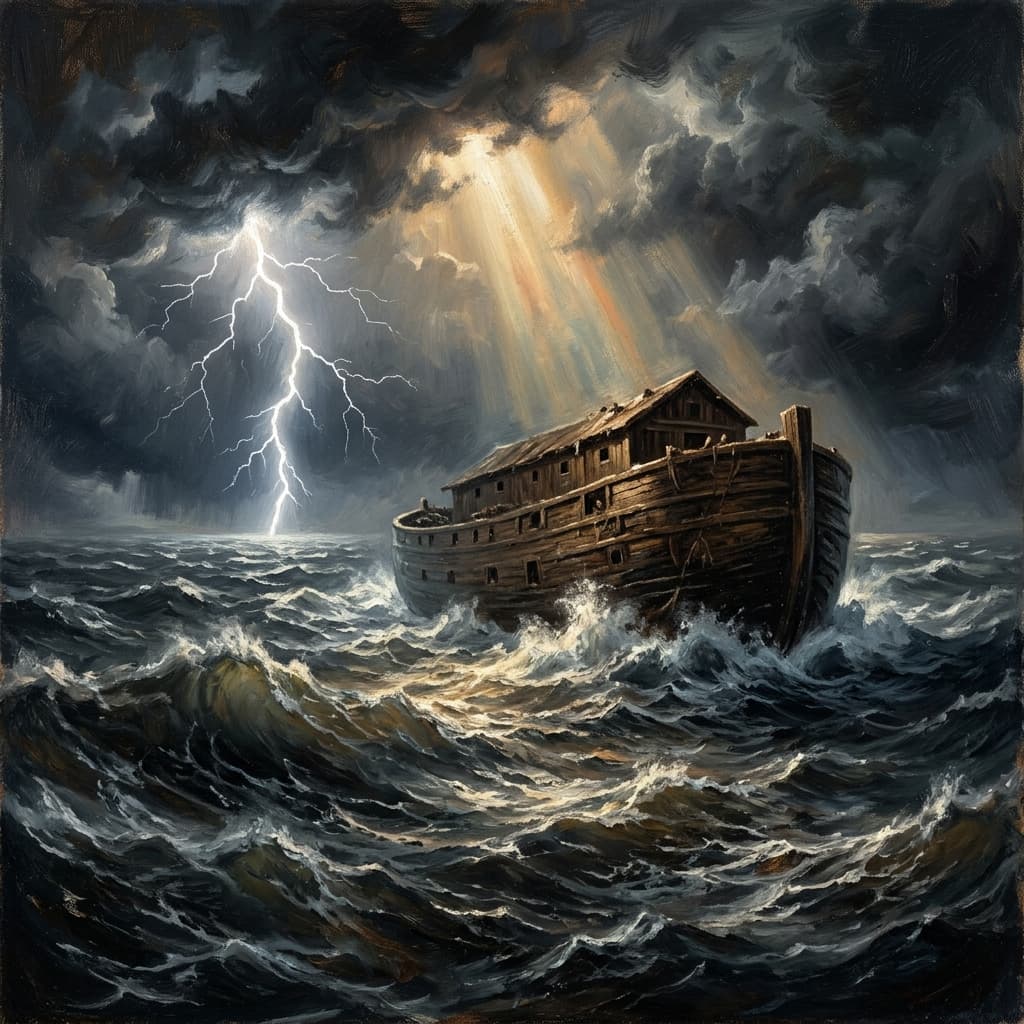
The command came when the oven at the house of Nuh began to gush water — that was the sign. The fountains of the deep burst open. The rain came down in sheets unlike anything any generation had witnessed. Nuh gathered a pair of every kind of animal, his family — except his son who refused — and those who believed. He said as he boarded: "In the name of God is its sailing and its anchoring. Indeed, my Lord is Forgiving and Merciful."
وَقَالَ ارْكَبُوا فِيهَا بِسْمِ اللَّهِ مَجْرَاهَا وَمُرْسَاهَا
""Embark upon it — in the name of God is its sailing and its anchoring.""
— Surah Hud, 11:41
Nuh saw his son standing apart from the crowd boarding the Ark. He called to him: "My son, come with us — do not be with the disbelievers!" His son refused. He said he would climb a mountain — that no flood could reach a mountain. And in the next moment, a wave like a mountain came between them, and his son was gone. Nuh called to God in anguish: "My Lord, my son was of my family!" The divine answer was the most profound and painful lesson in the story: "He was not of your family — his deed was not righteous." Family is not blood. Family is faith.
The waters rose until they covered even the mountains. Then God commanded the sky: "Hold back." He commanded the earth: "Swallow your water." The Ark came to rest on the mountain of Judi. The flood receded. What was left of the world was clean. A new chapter of humanity began. Nuh descended from the Ark and prostrated in gratitude — and God renewed His covenant with the human race, just as He had renewed it with Adam. This is the pattern: from every ending, a new beginning.
descendant
Ibrahim
Ibrahim was a descendant of Nuh — the Friend of God who would renew the covenant of monotheism thousands of years after the flood.