يُونُس
A prayer spoken in the deepest darkness — and why a whole city was saved
The Darkness of Three
The Departure
There is a difference between leaving and fleeing. Yunus left Nineveh before he was given permission to leave. His people had rejected him for years. He had warned them, reasoned with them, implored them. And they continued in their ways. He felt what any human being feels after sustained and fruitless effort: exhaustion, frustration, perhaps something close to despair. He left, expecting God's punishment to fall on the city.
He boarded a ship. The sea was calm at first, then a violent storm descended. The ship was at risk of sinking. In ancient maritime tradition, when a ship was in danger of being lost, lots were cast to determine who should be thrown overboard to lighten it. The lot fell to Yunus — three times it fell to him. He knew this was not chance. He had run from his post, and now the sea had found him. He jumped — or was cast — into the churning water. And a great fish swallowed him whole.
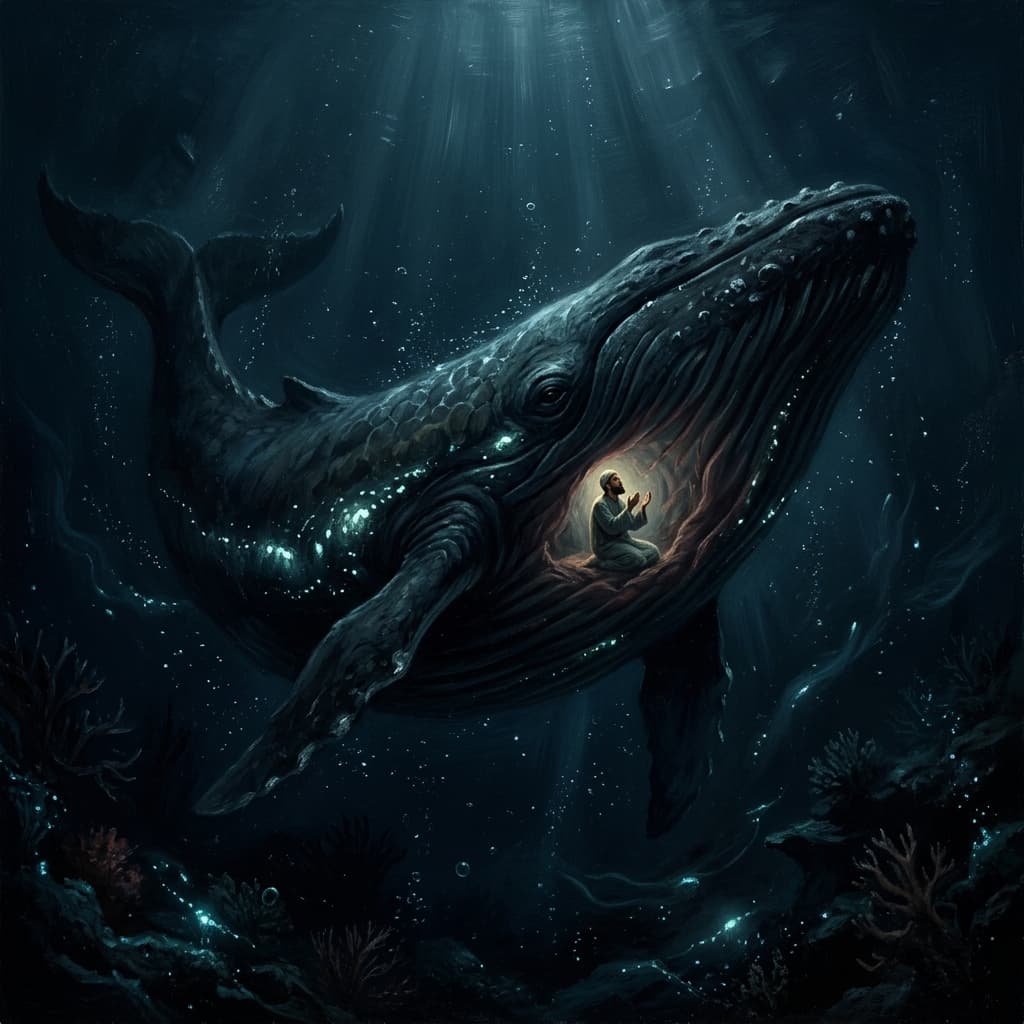
The Quran calls what followed "the darkness of three" — the darkness of the night, the darkness of the sea, the darkness of the fish's belly. Three layers of night, nested inside each other. Yunus sank into a silence and a darkness that no human being had ever experienced. He was not dead. But he was utterly, completely removed from the world of light.
The Prayer in the Dark
In the darkness, Yunus prayed. Not a long prayer. Not a complex one. Nine words in Arabic. But they may be the most powerful nine words ever spoken in the darkest hour:
لَّا إِلَٰهَ إِلَّا أَنتَ سُبْحَانَكَ إِنِّي كُنتُ مِنَ الظَّالِمِينَ
La ilaha illa anta, subhanaka, inni kuntu min al-dhalimeen
""There is no god but You, glory be to You — I was indeed among the wrongdoers.""
— Surah Al-Anbiya, 21:87
Three things in that prayer. The affirmation of God's oneness. The declaration of God's perfection. And the admission of personal wrongdoing. No request. No bargaining. No listing of what he had done right. Just the truth: God is God, God is perfect, and I was wrong. The Prophet Muhammad ﷺ later said: "No Muslim ever calls upon God with this supplication concerning any matter except that God responds to him."
The fish, by divine command, cast Yunus onto a bare shore. The Quran says he emerged "sick" — the Arabic suggests a man wasted and weak, like a newborn exposed on the earth. God caused a gourd tree to grow over him immediately, shading and nourishing him as he recovered. Then God sent him back to Nineveh — to the people he had abandoned.
What he found was extraordinary. In his absence, the people of Nineveh had felt the approach of punishment. They saw the signs — the sky changed, the birds behaved differently, something shifted in the atmosphere of the city. They did not wait for the punishment to arrive. They gathered in the open fields — every man, woman, child, and even their animals — and they repented together. The entire city, 100,000 people, called on God at once.
God accepted their repentance and lifted the punishment. Yunus' mission was accomplished — not through his years of effort, but in his absence, through the mercy of a God who accepted a city's collective turning. The Quran records that Nineveh was the only city in history to be fully saved after the signs of punishment had already appeared. And the key that unlocked it all was a nine-word prayer spoken in the belly of a whale, in the darkness of three.
The Prophet ﷺ said that anyone in distress who recites the prayer of Yunus — La ilaha illa anta, subhanaka, inni kuntu min al-dhalimeen — will be answered by God, just as Yunus was answered. The darkness of three is not unique to a whale in an ancient sea. It visits all of us: the darkness of circumstance, the darkness of our own choices, the darkness of distance from God. The prayer of Yunus is the lamp that lights the way back.